Willie Nelson Willie Nelson on the Road Again Meme
Classic Tracks: Willie Nelson's "On the Road Over again"
Like nearly country vocaliser/songwriters worth their salt, Willie Nelson operates outside the Nashville mainstream not necessarily because he'due south a major insubordinate
Like almost state vocalist/songwriters worth their salt, Willie Nelson operates outside the Nashville mainstream — not necessarily because he'southward a major rebel similar his friend and boyfriend Outlaw Waylon Jennings was, merely because he simply didn't fit in. With vocal phrasing that owes well-nigh as much to Tony Bennett as to Hank Williams, Nelson didn't sound the style producers expected country to sound. The consensus in Nashville seemed to exist that he had a great voice for songwriting.

Read more "Classic Tracks"
Buy the book
Nelson moved to Nashville from his home land of Texas in the early '60s, after playing honky-tonks and DJ'ing for several years in the Fort Worth surface area. While notwithstanding in Texas, he'd sold a song called "Family Bible" to a guitar teacher for $50. The song was later a hitting recording past Claude Gray, and Nelson felt encouraged to try his luck in Music Metropolis. He establish a friend and admirer in Hank Cochran, who helped Nelson go a publishing deal with Hal Smith's Pamper Music.
"I started working in a garage at the Pamper office," Nelson recalled in his 1988 autobiography, Willie. "In that location was a door, a window, a guitar and the walls. I started talking to the walls, like I had done when I was a child in Abbott [Texas], reading the pages of the Star-Telegram that kept the current of air out. Hank walked into the garage, and on a slice of cardboard I had written, 'Hello Walls.'"
The limerick that began with Nelson writing but "Hi Walls" became a awe-inspiring striking for country star Ray Price, and success began to follow success for Nelson: Billy Walker recorded "Funny How Time Slips Abroad," Price recorded "Dark Life" and Patsy Cline had an unforgettable hit with "Crazy."
Nashville still failed to cover him equally a performer, merely Nelson, itching to blow some of his sudden wealth and take a intermission from his home life (the moods of his marriage to offset wife Martha Gem Matthews apparently ranged from drunk to violent), won a spot in Cost's touring band, the Cherokee Cowboys. "I heard Ray Price'due south bass player, Donny Young — at present better known as Johnny Paycheck — had quit," Nelson wrote. "I talked Ray into hiring me to play bass with the Cherokee Cowboys. Ray didn't ask if I knew how to play bass, which I didn't."
The adjacent 10 years were a professional and personal roller coaster for Nelson. He partied away piles of cash, divorced and remarried, scored a couple of Top 10 duet singles with his second wife, Shirley Collie, and became a member of the Opry. He inverse labels a few times, releasing records with decreasing success, changed wives again and ultimately found himself back in Texas — Austin, this time — and fix to start the almost fertile period of his career.
Nelson'southward breakthrough anthology, Cherry Headed Stranger (Columbia, 1975), was a huge and surprising success — a concept anthology with spare arrangements, including Nelson'south heartfelt cover of Roy Acuff's "Blueish Eyes Crying in the Rain." Nelson shortly followed this with one of the biggest-selling country albums of all time, the collaborative compilation Wanted: The Outlaws, which glorified the Nashville-outsider status of Nelson and his practiced friends Jennings, Jessi Colter and Tompall Glaser. The Outlaws became more than an album; information technology was a crossover movement that won the hearts non only of land listeners, just likewise of higher kids, rock fans and hippies — outsiders all, and all under the radar of the Nashville establishment.
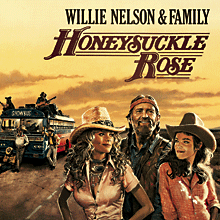
Nelson rode the success of The Outlaws to make his beautiful collection of standards, Stardust, which Nelson says moved his tough friend Jennings to tears and, like a handful of pop recording artists of the time, he was propelled to the big screen. He was tapped to brand Honeysuckle Rose, a movie that's part fiction, part concert film. Many of the songs to be used in the movie were already well-known, such as "Blue Optics Crying in the Rain" and "Whiskey River," but the filmmakers wanted Nelson to come up with a new song nearly touring to be the signature runway.

Engineer Bradley Hartman, 1980
"I was on a airplane with Sydney Pollack and Jerry Schatzberg presently after I signed to do the moving-picture show Honeysuckle Rose," Nelson recalled in Willie. "Sydney was the executive producer and Jerry the director, and they were talking to me near the music. They wanted a vocal. 'What kind of song?' I said. Either Sydney or Jerry said, 'Well, some kind of song about people traveling all over the land making music.' I said, 'You mean existence on the road again?' They said, 'Yeah, that's it!' I similar to bear witness off occasionally. I picked up an envelope, or maybe information technology was an airsick bag, and wrote:
"On the route once again.
I just tin can't wait to get on the road again.
The life I dearest is making music with my friends.
I merely can't wait to get on the road again.
"'How about this?' I said."
For much of the motion picture, live shows by Willie Nelson and his Family Band were recorded before audiences filled with lucky fans who had won the chance to be "extras" in radio giveaways. They were real concerts, with existent audiences, filmed to be role of a road movie virtually a fictional creative person.
The recording engineer for the picture music and the soundtrack album was Bradley Hartman, who had been with Brian Ahern'south Enactron Studios for a few years. He had recorded and mixed Stardust, equally well as other Nelson projects during the mid-1970s. "I wasn't in the union, and movies always take to be total-union, so they always had to have matrimony people hired to exist there, but I was actually working the controls," recalls Hartman, who also notes that the songs for Honeysuckle Rose were captured the mode he'd record a live concert album: "Showco was doing the live audio, and we interfaced and did a dissever off their audio."
Hartman recorded to a Stephens 24-track tape machine, using the Enactron truck's Neve console. "Information technology was one of the older, big Neve split up consoles with the inputs on one side and the monitor department on the other," he says. "Information technology was all recorded 24-track with SMPTE sync to the moving picture."
Hartman says Nelson sang into a Shure SM58 microphone, and he remembers using some boosted drum mics across what Showco had set upward. "I used some 451s for overheads," he says. "At that time, it was a crazy band that Willie had. At that place were two drummers — ane playing stick and the other playing brushes on top of it — and two bass players. There were two guitar players and Willie and Mickey Raphael playing harmonica. It was basically Willie'due south longtime band, plus a few extras."
The signature song, "On the Road Again," was recorded about a dozen times, in various venues and in front of different audiences, until Nelson, who was the producer of the tracks, and Hartman knew they had "the accept."
"We took the truck to Austin and San Antonio, and all around the Texas hill country on unlike locations to do the picture show," Hartman says. "In that location were a couple of clubs in Austin. We did the Hemisphere Arena in San Antonio. They found an old Texas-style dance hall out in the country in Fisher, Texas, where nosotros did several days of shooting. But the i that concluded up existence on the album and the single was i that was recorded at a club in Austin called Soap Creek Saloon. I don't believe information technology'due south there anymore, but nosotros worked in that location for two days. We prepare up and they brought in extras; it was like a free prove. We recorded 'On the Road Once more' two or 3 times in that location, and i take was just magical."
Four months subsequently the movie shooting was complete, Hartman took the tracks to New York City to assist with post piece of work. "I was involved in postal service-production on the picture show considering quite a few of the music performances are interspersed with dialog and activity," he says. Afterward, the project moved to L.A., where post was completed at Todd-AO Sound and Hartman mixed the album and single in Wally Heider's Studio four. "They'd just put in a new Neve 8108 panel and a new Ampex machine there," Hartman recalls. "They were calling information technology the 'Studio of the Decade' at that bespeak." He monitored on the studio's UREI 813 mains and A/B'd with Yamaha NS-x almost-fields.
Going back and listening to the recordings they'd made on location confirmed Hartman'south stance of which have of "On the Road" was the keeper. "It was but the energy that came off the phase," he says. "This take of it just jumped out. I mixed information technology a couple of times and fabricated sure the audience response was where it should accept been; there were 451s, audience mics in the society, and I blended those to go the energy of the audience, but the performance is totally alive."
Shortly after the Honeysuckle Rose movie was released, Hartman left Nelson's camp and became an contained engineer. "I did a few more things with Willie; I remixed a couple of singles for him, but that was pretty much the final thing I did. Pretty soon thereafter, he built his own studio [Pedernales] and moved all his stuff there."
Hartman went on to tape albums for Rodney Crowell and Rosanne Cash. His career later included a very settled period in the early 1980s, when he lived in L.A. with his wife and child, recording voices for a toy company called Alchemy II. "I recorded every word Teddy Ruxpin ever said," Hartman says with a express mirth. In the late 1980s, he moved to Nashville, where he at present runs his own studio, Trace Sound, and records mainly acoustic vocalizer/songwriters and bluegrass artists such equally Tim O'Brien.
Nelson, of course, continued edifice a much-celebrated career on his own terms. He won a All-time Country Vocal Grammy in 1980 for "On the Road Again," which continues to exist non only i of his trademark tunes, but besides his manner of life. "When I walk off the stage subsequently a hot testify," Nelson wrote, "I'k then wired on a natural high that for the next two or three hours, my feet barely touch on the flooring. Information technology used to be, when the regular show was over and everybody was roaring, nosotros'd get to a bar or somebody's firm and the band would keep playing until we could run into the sunlight through the windows and hear the birds singing outside. Now we get into our caravan of buses and exit town as soon as the show is over. In that location'southward plenty of fourth dimension to come up down when you're rolling all night on the highway."
Source: https://www.mixonline.com/recording/classic-tracks-willie-nelsons-road-again-365659
0 Response to "Willie Nelson Willie Nelson on the Road Again Meme"
Post a Comment